Sunday, 8 March 2026

Women in the Ramayana

Women’s day is when we talk about aspects of women empowerment. So I thought of choosing the lens of the Ramayana to see what we women can learn and implement to elevate our lives.

First, let’s have a small quiz. Here are the names of the woman character, and you must give me the name of their husband – ready?
1. Seeta
2. Sumitra
3. Urmila
4. Ahalya
5. Sunayana
6. Sarama


(You probably knew all the answers, except 5 & 6? Sunayana's husband is Janaka Maharaja and Sarama's husband is Vibheeshana)


Now let’s consider the behaviour of some of these women in the Ramayana and talk about what’s the lesson for us in it.


1. Seeta followed Rama into forest for vanavasa – stand by your spouse through the tough times. Marriage is for sharing both joys and sorrows together.


2. Urmila stayed back in Ayodhya while Lakshmana went to vanavasa – sometimes it’s your duty to hold the fort at home while your spouse fights his battles elsewhere. Have the maturity to accept and handle such situations.


3. Sumitra blessed Lakshmana when he insisted on following Rama to vanavas – when your child chooses the right path, although it may be difficult for you to see him suffer, give him your blessings. 


Now let’s see what NOT to do


4. Kaikeyi – was fond of Rama – but when Manthara evoked jealousy against Kausalya, Kaikeyi lost her power of judgement. Jealousy is the greatest monster that destroys our ability to think and reason. Be wary of it. Associate with positive and broad minded persons who uplift us, not those who pull us down!


5. Ahalya – fell prey to temptation – recognized that Indra was not her husband Gautama, but lost her head thinking that her beauty had captivated Indra himself. Steer clear of those who approach you with unholy intentions. Character of the woman is the most crucial to moral behaviour in the family.


6. Shoorpanakha – her immoral desire became the vehicle to cause destruction of entire rakshasa clan. When the woman of the house has ever-growing demands, it can drive the family to destructive ways of life.


7. Sunayana – Janaka’s wife – mother of Seeta. No mention at all of what she did when Seeta chose to go to vanavasa – let your married daughters take their decisions – don’t interfere with their life in a negative way!


8. Sarama – wife of Vibheeshana – retained her good and satvik nature even when in the middle of other rakshasis in Ashoka vana. Didn’t allow their evil behaviour to change her attitude. Stay committed to the right values in life no matter what others around you are doing.


Finally, here are two stories.


Story 1


After the killing of Ravana, when Hanuman went with good news to Seeta, he asked her permission to kill the rakshasis. She refused, saying they had only done what their king had ordered. She further said that all of us make mistakes – it is noble to forgive. Seeta’s mistake – to want the deer, and then speak harshly to Lakshmana. Rama’s  mistake – to listen to Seeta’s words and ignore Lakshmana’s. Hanuman’s mistake also – to stand and listen with interest about mistakes of Rama and Seeta!


Story 2


When pushpaka vimana was bringing back Rama, Seeta and Lakshmana and all vanaras from Lanka, they decided to take with them the vanara wives too.


Those vanara women were very curious to see the famed beauty of Seeta for whom the entire battle had been fought. They judged her on the vanara scale of beauty.


One said “Such big eyes Seeta has!”, another said “Such small waist she has”, third one said, “Forget all that – she has no tail only!”


Seeta heard all this – but only smiled. She who had forgiven the rakshasis who tortured her was not likely to take offense at the jabbering of the vanara women!


What's the lesson for us here? There will always be someone who has standards different from yours. Understand that their viewpoint is valid for them – don’t get annoyed by their comments, but don’t let that dictate your standards, either!

 Learn to draw a protective armour around yourself – "Not my circus, not my monkeys!”

Monday, 2 March 2026

The Fourth Rama

The two young daughters of the Srivaishnava Acharya Uyyakkondar were returning after bathing in the Kaveri. The path was blocked by a wide stretch of thick, slushy mud.

The little girls stopped, wondering how they would cross it.

Just then, Rama Mishra, their father’s shishya, arrived there.

Without another word, he lay down across the puddle, and said, “Don’t worry. Please cross over on my back.”

The girls were shocked and hesitated.

He coaxed them in a loving, but firm voice, and full of reverence, the girls crossed over gently, using his body as their path.

News of this reached Rama Mishra’s acharya, Uyyakkondar, and he summoned the disciple.

“My child,” he said, “what a great spirit of seva you have! Tell me what you desire, and I will grant it!”

Rama Mishra replied, “Swami, I desire nothing but to serve you always.”

In that moment, the guru knew that this shishya was no ordinary soul, but one who could be trusted to carry forward the guru Parampara.

From that day, everyone began calling Rama Mishra as “Manakkal Nambi.” The word “Nambi” is a title for a man who is full of divine gunas. “Manakkal” means “the one who bore the sandy footprints on his back.”

Years later, as Uyyakkondar prepared to depart this world, he called Manakkal Nambi close.

“There is one task you must fulfill,” he said. “The son of Ishwara Muni – Yamunai-thuraivar – you must guide him to carry forward our sampradaya.”

This Yamunai-thuraivar had been a brilliant young scholar. After winning in an intellectual debate, he had won half the kingdom to rule and was known by the name of Alavandar. Administrative duties, royal comforts, and worldly responsibilities slowly distanced him from his spiritual path. This was the person whom Manakkal Nambi had to transform.

When Manakkal Nambi came to see Alavandar, the palace guards refused entry. Nambi did not protest. He simply found another way.

Every day, Nambi brought a type of spinach called thuthuvaḷai keerai and gave it to the palace cooks, requesting them to cook and serve it to Alavandar. They did so, and Alavandar began to enjoy the dish greatly.

One day, the cooks stopped making the dish. Alavandar enquired why, and the cooks replied, “An elderly Srivaishṇava used to bring it. He has not come.”

“Find him,” Alavandar ordered.

A few days later, Manakkal Nambi returned, and was immediately taken to meet Alavandar.

“Swami,” he said respectfully, “please be seated. Tell me what wealth I can give you for your service.”

Nambi smiled. “I don’t want to take your wealth. In fact, I have come to give you a wealth that has been bequeathed by my Acharya.”

From that day, Manakkal Nambi began teaching Alavandar the meaning of the Bhagavad Geeta.

Slowly, Alavandar became a disciple again.

One fateful day, Manakkal Nambi explained the meaning of the Charama Shloka of the Bhagavad Geeta, which preaches surrender at the lotus feet of Krishna. He took Alavandar to Srirangam for darshan of Lord Ranganatha.

As Alavandar stood before Ranganatha, his heart melted. In that moment, the king vanished, and the bhakta was born again.

Eventually, Alavandar took the Srivaishnava sampradaya ahead, and it was he who “found” Ramanujacharya to be annointed his successor in the Acharya Parampara.

But for the intervention of Manakkal Nambi, these events would have been impossible. Paying homage to him in his Yathiraja Saptati, Swami Vedanta Desikan says,

अनुज्जित क्षमा योगम् अपुण्य जन बाधकम् ।
अस्पृष्ट मद रागं तं रामं तुरीयम् उपास्महे ॥

Anujjita kṣamā yogam apuṇya jana bādhakam
Aspṛṣṭa mada rāgam tam Rāmam turīyam upāsmahe

Meaning:

We meditate upon this fourth Rama – Rama Mishra (Manakkal Nambi)
who never abandoned patience, who never caused harm to any being,
and who was untouched by pride or worldly attachment.

There were three great Ramas known to the world before him:

Parashurama (whose rage was uncontrollable)

Dasharatha Rama (who killed the rakshasas)

Balarama (who was filled with attachment)

But this was the fourth Rama. Rama Mishra.

A Rama of perfect patience, perfect compassion, and perfect humility.

He did not fight any great battles. All he did was restore one soul to the fold, and by this, he ensured that the world continues to be guided and led to liberation through the teachings of the Srivaishnava acharyas.

Today, on the tirunakshatram (holy birth anniversary) of Manakkal Nambi, let us offer our obeisances to him, and pray to be guided to lead a meaningful life, filled with the wealth of seva.


Sunday, 8 February 2026

Katākṣham — The Glance That Liberates

Disguised as a wise mendicant, he stood before the two young men. They were dressed as ascetics, but their very aura proclaimed their royal lineage.

He spoke, determined to find out all about them without revealing anything about himself.

Yet, the very next moment, the truth slipped out.

“I am Hanuman, minister of the great King Sugriva, and he has sent me to say he wants to have friendship with you.”

Before Rama had even spoken a word, His mere look made Hanuman give up the subterfuge.

This shows us the power of Bhagavat Kataaksham – the gaze of the Lord.

But how does this happen?

The Mundaka Upanishad explains:

भिद्यते हृदयग्रन्थिश्छिद्यन्ते सर्वसंशयाः ।
क्षीयन्ते चास्य कर्माणि तस्मिन्दृष्टे परावरे ॥ ८ ॥

bhidyate hṛdaya-granthiś chidyante sarva-saṁśayāḥ |
kṣīyante cāsya karmāṇi tasmin dṛṣṭe parāvare ||

“When the Supreme Lord is seen, the knot of the heart is untied, all doubts are cut asunder, and the chain of karma is destroyed.”

In front of those Divine Eyes, what chance did Hanuman stand?

Nammazhwar knew this secret power of the Lord’s gaze. He begged the Lord repeatedly to bless Him with His darshanam.

Playfully, the Lord chided him, saying “You have so many paapas, how can I bless you?”

Desperate Nammazhwar pleaded, “You don’t have to bless me, at least just come and stand in front of me!”

Not realizing the ploy, the Lord acquiesced and appeared in front of Nammazhwar.

The very next moment, He found Himself pronouncing blessings!

The devotee had tricked the Lord. The obstacles posed by his sins were razed by the Lord’s own gaze! Now that the devotee was purified, the Lord’s blessings flowed spontaneously!

Image

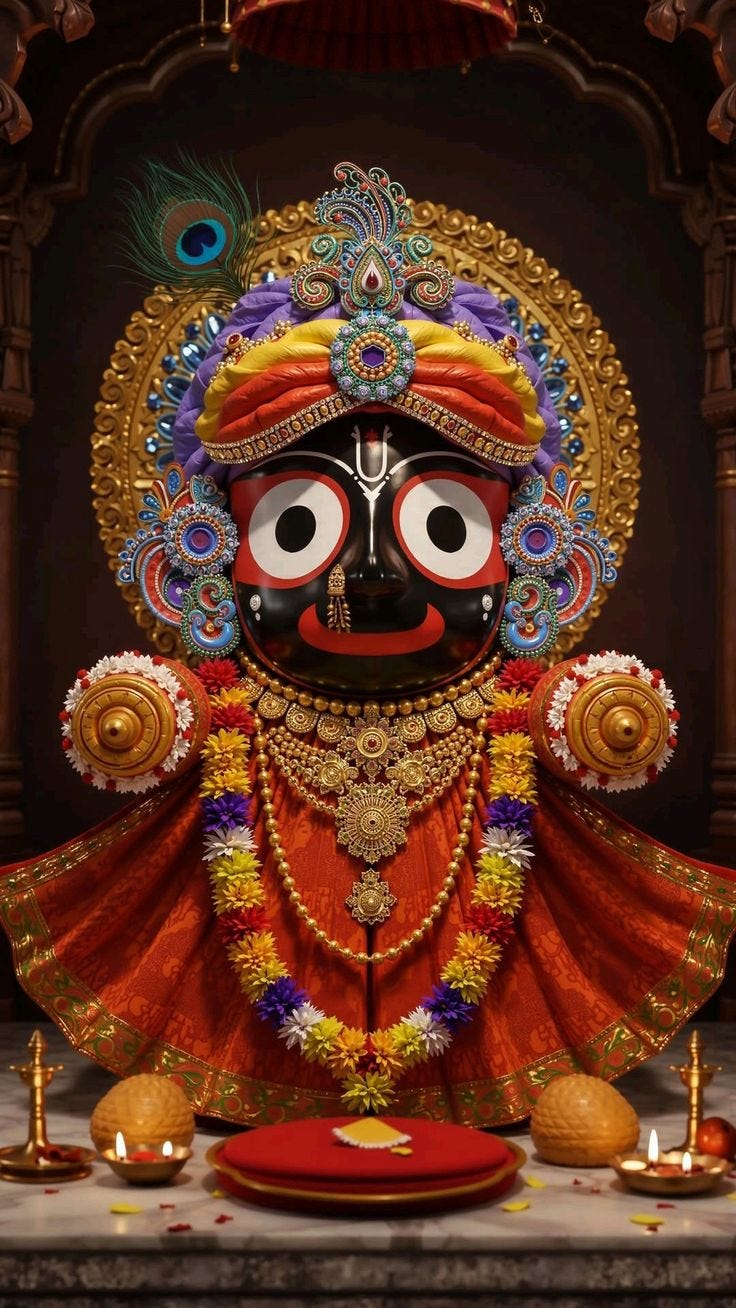
Have you seen the large, unblinking eyes of Lord Jagannatha at Puri? Those are the eyes that constantly watch over the devotees, not in judgement, but in a continuous shower of compassion. It is said that His eyes are so big because He has opened them very wide to find the tiniest bit of good in us, so that He can bless us. His eyes can see all our faults, and yet, so great is His karuna that it blinds Him to our faults!

The Vedas say the Lord has the Sun and the Moon as His eyes. When He glances on us with the cool Moon-eye, we are blessed. But what if His blazing Sun-eye is triggered by our unending paapakarmas? Won’t He then destroy us as He did Shishupala and Ravana?

To ensure this doesn’t happen, He has created His own ploy.

Image

In Tirumala, where He stands patiently receiving the never-ending queue of devotees, His eyes are largely hidden beneath the broad Thirumann adorning His forehead. In yet another of His leelas, He the Omniscient Lord, has ensured that He “cannot” see our sins clearly!

Yet again, we are the beneficiaries of His unparalleled compassion.

And if we are fortunate enough to feel His grace, and turn towards Him with love, that too is His doing!

The Shanti Parva of the Mahabharata reveals this rahasyam.

जायमानं हि पुरुषं यं पश्येन्मधुसूदनः।
सात्त्विकः स तु विज्ञेयः स वै मोक्षार्थचिन्तकः॥

“JayamAnam hi purusham yam pasyet MadhusUdhana:

SAtvika: sa tu vigyEya: sa vai MokshArttha chintaka:”

“One who receives the glance of Lord Madhusudana at the time of birth, is known to be sattvik and becomes a seeker of moksha.”

Anyone who is a sadhaka, a seeker of the Lord, is so because of the causeless mercy, the nirhetuka Krupa, of the Lord, which He rains down through His glorious eyes.

So, the next time you go to the temple, don’t start reciting from your list of what you want from Him.

Don’t rush to complete the darshan.

Just stand quietly, offer thanks to Him, and pray that He should bless you with His Krupa Kataaksham!

Footnote: I was only halfway through this post, when it was time to visit the Ranganathaswamy temple at Rajajinagar, Bengaluru. Standing in front of Him, it felt as if He was smiling bemusedly and asking,

“Do you think you can really convey the full extent of My kataaksham through mere words?”


Well, dear readers, the answer is for you to say.

Sunday, 1 February 2026

Kausalya Supraja Rama

The forest is silent. The eastern sky is tinged with a mild glow as the sun prepares to rise. The rishi sits up and glances at the face of the young prince sleeping near him. He finds himself unable to look away. Moments turn to minutes as he stares, mesmerized, flitting between emotions of love and awe, amazed at his great fortune to behold this beautiful sight.

Perhaps it is the lightening of the skies, or the chirping of the stirring birds, but now, the rishi wakes from his reverie.

Gently, he calls,

“Kausalya supraja Rama, Kausalya supraja Rama….”

And finds himself about to slip into a trance again….

Using the immense power of his tapas, the rishi finally pulls his eyes away and manages to complete what he was trying to say.

“Kausalya supraja Rama poorvaa sandhyaa pravartate,

utthistha narashaardoola, kartavyam daivamaanhikam!”


“O good son of Kausalya, the dawn is approaching in the east. Wake up, O tiger among men, it is time to perform the daily ritual duties!”

This is Brahmarishi Vishwamitra waking up Rama whom he has brought into the forest to protect his yagna.

Vishwamitra marvels at the great fortune of Kausalya who got to bear this divine child. He wonders how much tapas that mother must have done to be able to glance at this radiant face and wake up this dear child every day.

If he recognizes the divine identity of the young prince, why then is the rishi exhorting Him to perform the daily ritualistic duties? What duties does the Supreme Lord have to perform, and why?

The simple answer is – to set an example for us. Humans tend to look up to great people and emulate their actions. Rama is addressed here as “narashaardoola” – tiger among men. That means He is definitely a great man whom the world will hold up as an ideal for centuries to come.

By performing the nitya anushthaana, Rama must set an example for us to follow.

As Krishna aptly explains in the Bhagavad Geeta,

yad yad acarati sresthas, tat tad evetaro janah
sa yat pramanam kurute, lokas tad anuvartate

Whatever action is performed by a great man, common men follow in his footsteps. And whatever standards he sets by exemplary acts, all the world pursues.

- Bhagavad Geeta, 3.21

The acharyas also give another reason for Vishwamitra waking up Rama thus. Perhaps he is saying, “O Rama, You have taken this human form to annihilate the evil asuraas and rakshasaas. Now is the time for You to wake up from Your life as Dasharatha’s son, and begin to take steps to fulfil the promise given to the devaas!”

If we look closely at Vishwamitra’s call, we realize that he’s calling out to Rama alone. Why not Lakshmana? Because he didn’t see Lakshmana at all!

Well, Lakshmana never left Rama’s side, then where was he when Rama was sleeping?

Actually, this is the form that Vishwamitra saw….

Rama sleeping ON Lakshmana ! 

The Lakshmana who was none other than Adishesha!


Look at this beautiful form. Is it any wonder that Vishwamitra was so fascinated?

And once you come out of your reverie of gazing on this divine Lord, perhaps you will want to go back and yourself say those words uttered by Vishwamitra.

“Kausalya supraja Rama poorvaa sandhyaa pravartate,

utthistha narashaardoola, kartavyam daivamaanhikam!”


And just in case you haven’t recognized it yet, and are wondering why this sounds so familiar, it’s probably because you’ve often heard M. S. Subbulakshmi singing it as the first verse of the Venkateshwara Suprabhatam!

Thursday, 15 January 2026

The Best Harvest

As she went about her housework, there was a call from someone outside the door.

“Swamin, we are Srivaishnavas traveling to the next village. Can we get some water to quench our thirst?”

The lady hurried out, welcomed the tired travellers, seated them comfortably and offered them water, noting their fatigue.

“My husband has gone out somewhere, but you are welcome to rest here. Please wait for a while, and partake of some food in our humble abode.”

The weary travellers gladly agreed to the offer.

She rushed inside, got the wood fire going, and pulled out the pots and pans to start cooking. Peering into the grain bin, she was dismayed. The rice in it was too less to suffice for the entire group of people she had promised to feed!

She rushed to the store room. No rice there either!

Panic-stricken, she fell back on her first resort in such situations.

She began praying to her Acharyar and chanting the names of the Lord, as her gaze darted here and there in the store room.

In a few minutes, she walked back into the kitchen, carrying a small bundle in her hand, and began cooking in earnest.

Pic courtesy: https://www.instagram.com/p/C1W151ASJJX/ 

One hour later, the Srivaishnavas had been served, and they left, thanking and blessing the woman for her kind hospitality.

The next morning, the woman’s husband returned home. He had brought along someone to help with the work of sowing their fields. Rummaging amongst the sacks in the store room, he called out to his wife.

“Have you seen the bundle of paddy I had saved up to sow our next crop? I’m sure I had kept it here, but it seems to have disappeared!”

She walked up to him with a tremulous smile.

“The sowing has been completed.”

“What?! How? When? By whom? Don’t tell me the crop is ready to be harvested, too!” the farmer chided.

“Yesterday, I did the sowing. And we will harvest the crop in Srivaikuntham, although I don’t know when exactly that will happen!”


In the Bhagavad Geeta, Sri Krishna says:

अद्वेष्टा सर्वभूतानां मैत्र: करुण एव च | 

निर्ममो निरहङ्कार: समदु:खसुख: क्षमी || 13||

सन्तुष्ट: सततं योगी यतात्मा दृढनिश्चय: | 

मय्यर्पितमनोबुद्धिर्यो मद्भक्त: स मे प्रिय: || 14||

adveṣhṭā sarva-bhūtānāṁ maitraḥ karuṇa eva cha
nirmamo nirahankāraḥ sama-duḥkha-sukhaḥ kṣhamī

santuṣhṭaḥ satataṁ yogī yatātmā dṛiḍha-niśhchayaḥ
mayy arpita-mano-buddhir yo mad-bhaktaḥ sa me priyaḥ


Bhagavad Geeta Chapter 12, verses 13-14

"Those devotees are very dear to Me who are free from malice toward all living beings, who are friendly, and compassionate. They are free from attachment to possessions and egotism, equipoised in happiness and distress, and ever-forgiving. They are ever-content, steadily united with Me in devotion, self-controlled, of firm resolve, and dedicated to Me in mind and intellect."


मत्कर्मकृन्मत्परमो मद्भक्त: सङ्गवर्जित: | 

निर्वैर: सर्वभूतेषु य: स मामेति पाण्डव || 55||

mat-karma-kṛin mat-paramo mad-bhaktaḥ saṅga-varjitaḥ
nirvairaḥ sarva-bhūteṣhu yaḥ sa mām eti pāṇḍava

Bhagavad Geeta Chapter 11, verse 55

Those who perform all their duties for My sake, who depend upon Me and are devoted to Me, who are free from attachment, and are without malice toward all beings, such devotees certainly come to Me.

On today's auspicious occasion of Pongal and Makara Sankranti, let us pray that the Lord guides us to strive for the right harvest!