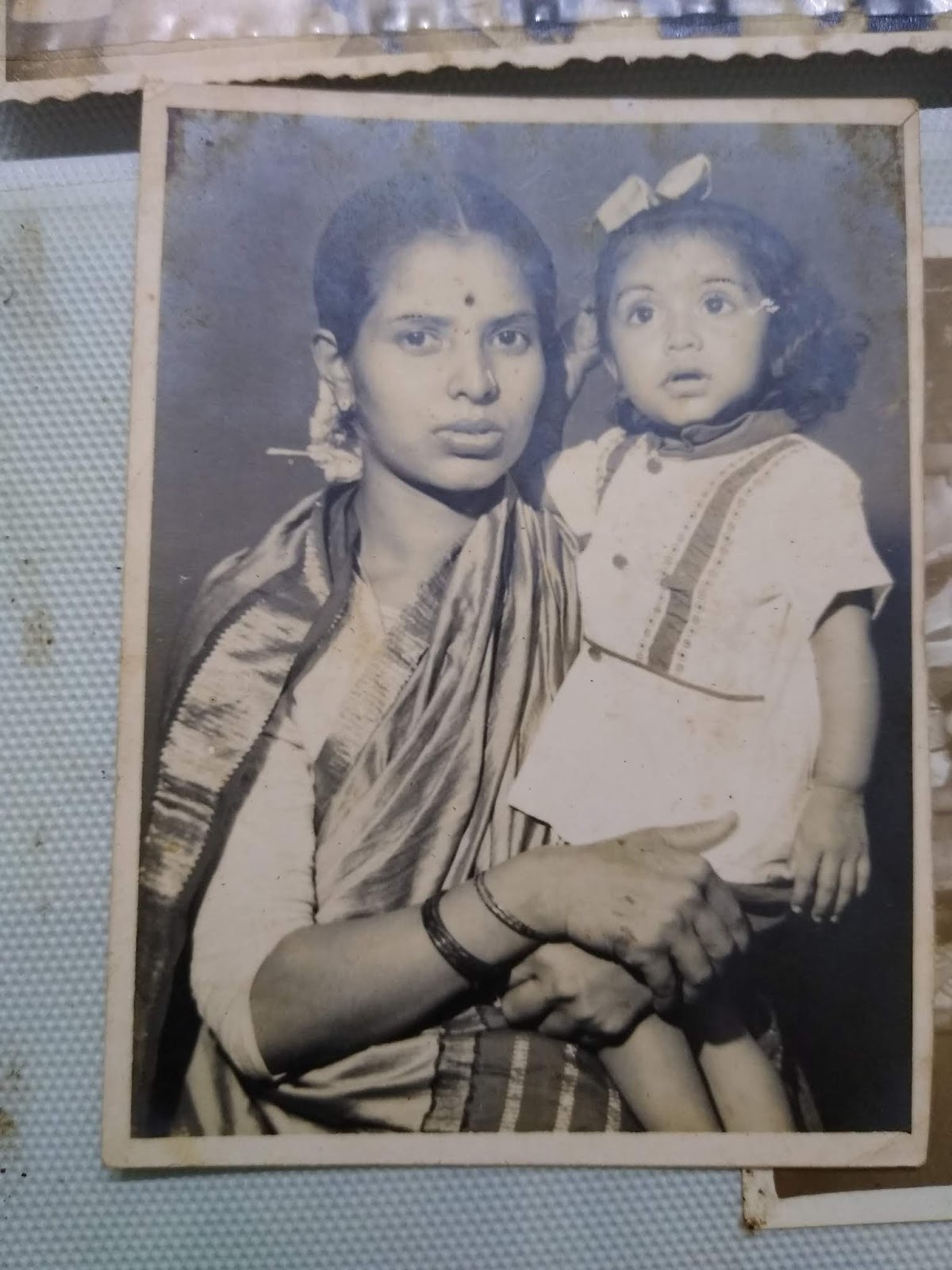
Tuesday, 19 November 2019

NaBloPoMo 2019: Day 19: To Care is to Share


Once, when my three oldest sisters were in middle school or so, my father set them a challenge to make them study better. The one who scored the highest marks would get a gold chain.

(I was a little surprised when I heard of this because I’ve heard Appa boast that we were all always serious about studies and hardworking without having to be forced to study. Or perhaps that was just his paternal pride that exaggerated our qualities? 😜 )

Anyway, the girls all did their part and the youngest one of them, Vatsala, (whom we have classified as the brainiest one) scored the highest marks. God knows how he managed it, but within 15 days, Appa somehow bought the gold chain, brought it home, and after placing it in front of God, it was clasped around Vatsala’s neck.

Before there could be any repercussions of this event on the other two girls, Amma stepped in and announced that the gold chain was for all 3 of them and not just Vatsala; they all would get to wear it by turns for a few days each. Her fairness (and tact) saved the day!

I don’t think Appa offered any more such incentives for academic performance after that…

This incident is just a reflection of how Amma cultivated in her daughters the sense of sharing happily with others.

During summer vacations, all the Kashi clan went to the family home in Ramnathpura. The house was small, but the kids had fun bathing in the Kaveri river flowing close by and playing together with their cousins.

The children would go to the temple at the time of the morning and evening puja. When they returned home, my sisters would all bring the prasadam given to them and hand it over to Amma, for distribution to everyone at home. The other elders in the family used to appreciate them for this sharing nature when compared with the other kids who would gobble up their share of the prasadam in the temple itself. But then, those kids didn’t have Amma to guide them otherwise!
There’s another interesting thing I’ve heard from some of my older cousins who are my elder sisters’ age. Whenever some special food was brought to the house – a sweet, or watermelon, or mangoes, or anything out of the ordinary – the kids would unanimously demand that the distribution of that food between all the cousins should be done by Amma. Guess why? Of course, because they knew she would divide it equally between all the kids, without favoring her own over the others!


Much later, when we had moved to Bangalore, one of our relatives who weren’t too well off, got married and had to set up an independent house. Without being asked, on her own initiative, Amma gave the young couple some utensils, plates, glasses, etc to reduce their burden.

When I hear people complain about fights with their siblings, I never can understand how sisters can quarrel over things. For it never happened in our house despite 6 girls living together. (Touching wood, here, to ward off any evil eye 😀)

A few months ago, when Amma’s ornaments were being distributed as per her will, we all took what was given to us with gratitude but the first thing each one said was “If anyone of you wants to keep this or wear it anytime, all you need to do is ask!”

Amma is no longer here, but her legacy continues…………


Monday, 18 November 2019

NaBloPoMo 2019: Day 18:Pray Together, Stay Together...

After staying in Pali for few years, Appa got transferred to the mines in other locations, and so, we moved to other places like Surla (where I was born), Sirsaim, Tivim, and Ponda (where the youngest daughter Komala was born) and then back to Surla again. 

When we were in Ponda, one day, Amma had gone to the grocery store. She heard two people talking in Tamil and felt moved to talk to them. They (Mr. Vallal and Mrs. Vaidyanathan) talked nicely to her and invited her to join in their bhajan group that met every Saturday evening, in each person’s house, by turns.

The host would set up the prayer altar, spread mats for people to sit, and prepare the prasadam. Everyone would join in singing the bhajans in a set sequence; most parts would be sung in “lead and follow” style; the session usually lasted about 2 hours or so. It would end with an arati and prasadam.

Amma had put the old Salgaocar diaries to good use by diligently writing down all the bhajans and naamaavalis sung at these times.  
Amma learned Marathi after coming to Goa.
Amma was meticulous...note the red circles - they tell how often to repeat that particular line. 


Kannada script - Amma's handwriting
Some of the Tamilians from the bhajan group were young boys in their early twenties, working in Goa and living far from their native land. Many of them worked in MRF Tyres near Ponda.

Amma had picked up the pure version of Tamil from the Tamil maamis who were part of the bhajan group. She was kind and affectionate to these young men, and in her, they found their mother-substitute. Sometimes, they would come over to our house in the evenings. She would serve them coffee with savories. Then she would force them to stay over for dinner, and they’d happily agree. All these boys were exhilarated when bhajan was in Rama Iyengar Maama's (our) house because prasadam would be tasty, and of course, in plenty!

One of the boys was a descendant of the famous musical doyen Muthuswami Dikshitar who is one among the revered musical trinity in Carnatic music (the other two are Tyagaraja and Syama Sastri). This guy took music lessons for my older sisters, teaching them the basics of Carnatic music until we lived in Ponda.

Two of the maamis in the bhajan group also started conducting the Chinmaya Mission’s Bala Vihar classes on Sunday mornings. I remember attending those classes and learning small prayers there. It seems I even won a prize when I was maybe 5 or 6 years old, for singing a bhajan in some competition.

Nothing in this world happens by chance. 

Amma had already sown the seeds of bhakti in us children by telling us stories from the Ramayana and Mahabharata, and from Bhakti Vijaya. Our family outings used to be not to movies or the beach or the zoo, or ‘shopping’ but to pravachans and kirtans. The atmosphere of the bhajans in Ponda served to cement our fledgling faith in God and helped it take root deep within ourselves, and bound us even closer together as a family. Till today, our best moments are ones when we are in a bhajan at Amma’s house.

For us, thank God, it has truly been a case of, “The family that prays together stays together!” 


Sunday, 17 November 2019

NaBloPoMo 2019: Day 17: Status-aware Amma!


When living in Pali, Amma herself created a mud stove on the kitchen platform. It had two parts – one big space that would receive the strong flame, and the second smaller space where a slightly lower temperature would be maintained (like the “sim” option in today’s gas stoves).

While wood was the main fuel, it was costly; besides, it would take longer to kindle. So, Amma made good use of dried cowdung cakes ….which she prepared herself….like this…

Early every morning, cows passed by our house as they went grazing. Under cover of the dim light, Amma would collect the cowdung they left behind, and store it behind the house. Later, at around 12.30 – 1.00 pm, she would take that dung out, make sure no one was watching, and pat it into cakes on the rocky boulders that lined our backyard, leaving them to dry out.

Why all the secrecy around this task that many other housewives may have been doing in those days?

There was an office of the mining staff in the space beyond the boulders of our backyard. A window of that office was so positioned that people in that office could see what went on in our backyard.

Amma didn’t want them to see her doing this cowdung-drying task because by then, Appa had been promoted to a Manager. She didn’t want people to think, “See what Manager’s wife is doing!”

Yet, she was overly aware of the responsibility of having 4 daughters to be married in the years to come; so, she simply did the best she could, to economize and save money.

On another occasion, Amma had come with the 5 of us kids for her stepsister’s wedding in Bangalore. Appa had dropped Amma at her parents’ house and gone; he was to come a few days later to pick us up. I was a 2-year old baby then.

Amma’s maternal relatives always tended to be a little self-centred in the clichéd way in which rich people don’t really bother about their poor relatives. It so happened that they all left for the wedding hall by their vehicles, leaving us behind. Amma wasn’t at all familiar with Bangalore city and so, we just began walking in the general direction of the hall. Luckily, Amma’s uncle was passing by and he took us in his car.

After the wedding, again, the same scene repeated itself. Everyone went away, and this time, that uncle too wasn’t around. Amma didn’t want to take a jatka gaadi (horse carriage) because she didn’t know the route – what if the driver took away this lone lady with 5 girls somewhere…etc etc…

So, Amma decided they would walk the 3-km or so distance home. They would be safe on the road, and could get back by asking passers-by for directions. With me on her hip, and holding the other girls’ hands, she trudged the lonely distance back to her parents’ house. When they had almost reached, it seems she told the kids, “If anyone asks how you came, say we came by jataka gaadi.” Again, she was keeping up appearances because she didn’t want people to think bad about her husband’s financial condition.

When Amma had narrated this incident to me, I’d felt angry at how she had been treated by her own people. When I said as much, I remember Amma saying, “It was all so long ago. They were also young….they didn’t know better, riches tend to cloud people’s minds…it’s not so easy to overcome that. Leave it, don’t get worked up over something that I myself have forgiven long ago.”

As the years rolled by, situations changed…we girls studied well and supported our parents financially, and our conditions became more comfortable than before. But most importantly, thanks to the way Amma and Appa brought us up, and God’s grace, we continue to be blessed with a richness of spirit that mere money can never buy! 


Saturday, 16 November 2019

NaBloPoMo 2019: Day 16: Sowing the right seeds – Discipline and Bhakti

Picture this scene.

A lady lying on the floor with a pillow beneath her head, holding a book in her hand and reading from it. Twirled around her are 4 little girls – one each on her left and right sides, one near her legs, and one lying with her head on the lady’s tummy. Once in a while, the woman’s eyes close, her voice slurs, and the book slips from her hand….the girls immediately shake her awake, and urge her to continue reading and finish the story…

Guess which super-interesting story this woman may have been reading that the girls were listening to with such rapt attention? 

I'm sure you got it wrong.....

Every afternoon during school vacations, Amma read to her daughters, stories of saints like Gora Kumbhar, Kanhopatra, Chokhamela, Sakhubai, Tukaram and many more from the book called “Bhakti Vijaya” ! 


My sister Vatsala remembers:

We would wait for lunch to get over and for Amma to come and read the stories. She would be tired after having worked non-stop from early morning and so, while reading, would doze off in the middle. We all would shake her awake, saying, “Don’t sleep, read this story, read that story,” each one asking for her own favorite. Till today, I can remember that scene. I have no words to describe how I feel …. so grateful for all the effort she took, despite her own exhaustion, to sow the seeds of Bhakti (devotion) in us, little children!

During Deepavali and Christmas holidays (and summer vacations when they didn’t go to our native place), Amma would wake the kids up at 5 am. The 4 girls would sit on the sofa, and she would teach them stotras (devotional hymns) such as Venkatesha Suprabhatam and Mukundamala. They followed the “santhe” system of learning – Amma would say a line once, and the girls had to repeat it twice. This went on until 6 am.


After this, the kids could go back to sleep and wake up later by 8 am, or they could have coffee and relax and then go for a bath. No such relaxation for Amma though – she’d begin her day’s work and keep at it till after lunch when she took a small break.


Amma didn’t just preach discipline to her daughters, she led by example. Weekday, weekend, holiday, working day – breakfast, lunch, coffee, dinner – all would be on time just as usual. No relaxation in her routine ever. When there was more work to be done – as on festival days, Amma would wake up earlier to deal with the extra work – no compromise on any of the rituals ever.


My sister Vijaya adds:

Amma used to tell us how she would enjoy going for early morning walks with her father and Chinnattai, and they would chant the mantra “Hare Rama, Hare Rama, Rama Rama Hare Hare, Hare Krishna, Hare Krishna, Krishna Krishna Hare Hare.”


Amma used to push us to wake up early on holidays as she had learned from her father that it is healthy and the right thing to do.


Once when we visited our grandfather’s house during some function, Amma saw that her own younger siblings were sleeping till later in the morning and that her father had not managed to change it. Seeing this, she talked to us about it, and from then on, she relaxed her conditions a bit for us kids.

Amma’s father had told her to recite the Sristuti (composed by Vedanta Desikar) as it will bring good things her way. So she used to recite it daily. 


Whether she was cooking, or doing the housework, she would be reciting some or the other stotras. By creating a saatvik atmosphere for all of us at home, she provided an environment that fostered the sense of Bhakti in all her daughters.


Friday, 15 November 2019

NaBloPoMo 2019: Day 15: A stitch in time…

Appa used to visit our native village in Hassan district of Karnataka twice a year for the shraaddha (annual death ceremony) of his mother and father. Each trip (including the 2-way travel) would last around 5 days; occasionally if his brothers insisted, Appa would stay back a day or two longer. Once the 5 days were up, if Appa hadn’t returned, Amma would begin to feel a little concerned. 

My sister Vijaya narrated an incident that happened during one such annual visit.

One day, late in the evening, Amma was in the kitchen. Suddenly, she ran into the hall and then out of the house. In a few minutes, she was back home and we asked why she had run out like that.

She had heard the news on the neighbor’s radio through the kitchen window. There had been a mention of some train accident in Karnataka. Since Appa hadn’t yet returned from the shraaddha visit, she anticipated the worst and rushed to the neighbor’s house to check.

She had no idea which train he was traveling by or the train number or anything – it was just a reflex action born out of panic.

After a day or two, Appa returned home safely.

A few days later, Amma joined the tailoring class being run by the Mahila Mandali in Redi. Because she had wakened to the fact that if something happened to Appa, she must have some way of supporting her family and taking care of her children!


My sisters have some faint memory of how she would leave them playing outside the house in the early evening, lock the house, and go for her tailoring class. It can't have been easy, but she went through with it anyway!

Slowly, Amma’s tailoring skills picked up. She stitched all our dresses at home, including our school uniforms, and her blouses too. Till she was 60, Amma continued to stitch her own blouses.

When we began buying clothes from outside, she would do the necessary alterations for length and put an extra stitch to reinforce the flimsy ones.

Amma used to make the special kind of patchwork quilt called Godadi using bits and pieces of colorful cloth from old clothes, held together with a backing of an old cotton sari. When her daughters became mothers, Amma welcomed her grandchildren with the tiny Godadis and langotis made out of Appa’s old panches (dhotis).
Baby godadis
An eye for color!


Baby langoti
(Picture credit for baby godadis and langotis: Komala)

After we moved from Goa to Mysore, we sold the old sewing machine in some exchange offer and bought the new Singer Fashion Maker which allowed one to do embroidery too. The company was offering a free training session for 15 days. I attended that training program because I was home (from Goa where I was studying M. Pharm).

From me, 56-year old Amma learned how to use that machine to do zigzag for sarees! Over time, she practiced her skills and as she grew in confidence, she began stitching saree falls and doing the zigzag for our neighbors. As the news spread by word of mouth, she was often flooded with work, which she handled systematically and delivered on time.

She wouldn’t charge much – just a little more than the cost of the fall. She liked to keep herself occupied and the money was a little bonus.

As my sister Vatsala points out, Amma never gave any thought to her comfort. She wouldn’t brood over how difficult something was, or whether it would be possible to do a particular task or not – all her energy was always focused on how to get it done in the best way possible.


Thursday, 14 November 2019

NaBloPoMo 2019: Day 14: Pictures of the Past

Reading yesterday’s blog post, quite a few people responded saying that they hadn’t known about Amma’s demise. Not their fault, for I hadn’t gone out of the way to tell people about it, except incidentally. 

Ever since the event, I had been meaning to write a blog post, sharing the news and my experience of it, and a few things about how Amma’s life had been. But somehow, there was no pull from within and I sensed the need to let some time pass before venturing there, trusting that when the time was right, the impulse to write about it would come.


I hadn’t really planned on writing this blog series. I wasn’t even sure if I’d do the blogathon this time because of late, I’ve been extremely busy. Besides, there’s a textbook I’m writing and supposed to complete by this month-end.


Then just one day before November began, I was struck by the thought of making this November about Amma. As usual, I turned to my sisters to ask what they thought of it, and if they’d tell me their stories, too, because being No. 5 in the list of 6, there were many things I didn’t know in detail.

Within minutes their replies poured in – yes, it was a great thing, and of course, they’d contribute!

Now because I hadn’t planned for the event, I wasn’t equipped with the photographs to go with each story. But when I went home for yesterday’s maasikam, I made up for that deficiency. The night before the maasikam, I sat up till late, scouring through the family albums, for pictures to use for the stories so far, and the ones to come in the days ahead.

Here are a few photographs of places and people I’ve talked about in the blogs so far. The pictures tell their own story!

Redi pictures

Amma with her first-born (Maithili) She must have been 21 then.
Amma with a Mahila Mandali group in Redi. Note that she's wearing the madisaar. 

The family to your left is ours. Appa, Maithili, Amma with Vatsala in her lap, and Vijaya

The first three - Maithili, Vijaya and Vatsala

 Pali pictures


Standing in order from eldest to youngest - Bhargavi is the fourth kid


Pali house where Bhargavi fell - the 4 girls, not sure if woman almost hidden is Amma

Our maternal aunt's marriage. Girls on the floor are us - the baby in the lap is me. Elderly person in center - our grandfather Engineer Narasimhamurthy. To his left - Amma and Appa

Most recent picture of all 6 of us with Amma and Appa
That Mahila Mandali I mentioned in the Redi pictures is where Amma learned the basics of stitching. I'll talk more about her tailoring skills tomorrow.


Wednesday, 13 November 2019

NaBloPoMo 2019: Day 13: The Monthly Ritual

Wake up early.


Sweep and mop the house.


Bathe and dress in ‘madi’ clothes.*


Drape the madisaar.**


Consume nothing – not even a drop of water. 

No visits to the washroom either


Step into the kitchen and start cooking.


Use only vegetables and ingredients native to this country.


Cook around 15 different items. In quantities sufficient to serve about 15 people.


Wait for the Brahmins participating in the rituals to finish their meal.


Serve the officiating priest and the performer of the ritual, and the other guests.


Finally, sit down to eat your first morsel of the day. At around 3 pm.


Clear up the kitchen and the rest of the house, putting things back in place.


Through it all – talk, laugh, argue, pull each others’ legs and reminisce about the good old days.


Go back to your respective homes.

Repeat next month. 


This is been the routine of Amma’s daughters one day every month after May 2019. And also the routine for our cousin Shri. Prasanna, who is gracefully doing the rites on behalf of Appa (since Appa is too old and incapable of doing them). 

We’re doing things we haven’t done before. If the reports of those who attend Amma’s maasikam ceremony (monthly rites for the departed during the first year following death) are to be believed, we’re doing a pretty good job of it.

Today was Amma’s 7th month maasikam. 


There are some who ask why we take all the trouble when even sons in today’s times don’t do the rites for their parents.

Our answer – for a mother who did so much for you your entire life, and shaped you into who you are today – it’s a small thing to do in return to ensure her atma gets all it needs on its journey beyond this world.

* Madi clothes - clothes washed the previous day and left untouched and worn only after a purificatory bath.


** Madisaar - saree worn in the traditional style.