Sunday, 19 July 2026

Two Temples. One Reminder.

Mathura. Krishna Janma Bhoomi.

I stood in a fast-moving queue, carried along by the quiet urgency of devotees around me. The next moment, I was before the very place believed to be His birthplace—the small, unassuming prison cell where Krishna was born.

The Bhagavatam says that simply hearing of His birth in that prison loosens the fetters of our own existence—the endless cycle of birth and death, of samsara. Standing there, in that tiny space, the weight of that thought overwhelmed me. Tears came unbidden remembering the Sowlabhyam – the accessibility of the Supreme Lord. He chose to enter the world in chains, only to free us from ours.

I stepped out, still carrying that feeling within me, and walked past a small shop selling devotional items. I bought a tiny Krishna vigraha. When the shopkeeper handed it over to me, I was about to put it into my bag. He gently stopped me.

“Don’t just put Him inside like that,” he said.
 “Call Him lovingly—‘Lalla, come… let’s go home.’”

In that simple instruction lay a depth of devotion that gave me new vision. Through this simple shopkeeper, Krishna was reminding me that He was not an object to be carried but a presence to be invited.

Humbled, I lifted the small vigraha, touched it to my eyes and forehead, and silently did as he said. Lalla, come… let’s go home.

Today, He sits in my pooja room—quiet, compassionate, watching over the many things we do right and wrong. And yet, through it all, He continues to bless.


Another journey few days later.

Bhavishya Badri. The place where it is believed that Lord Badrinath will reside in the future, when the present-day Badrinath Dham becomes inaccessible.

Reaching there was a pilgrimage within a pilgrimage—a 45-minute jeep ride from the main road, taking us deeper into stillness. The landscape unfolded into an untouched, pristine space. There was no noise of the world—only the wind whistling through trees, weaving its way between mountain peaks and valleys. The air itself felt different—pure, gentle, filled with a kind of sattvik calm that is hard to describe.

At some point, I noticed that not only was there no internet connectivity, there wasn’t even a trace of a mobile signal.

After darshan, as we made our way back to the jeep, we came across a man selling hot herbal tea. He had a simple setup, offering samples for ₹20. A few of us tried it.

When it was time to pay, almost instinctively, my husband asked, “UPI?”

The man smiled.

“No phone network here, Sir,” he said.

And then, with a quiet conviction that made us all pause, he added,

Here, everything is only Narayan network.”

We all laughed—but I was struck once again by the profound faith of this herbal tea seller that allowed him to feel and rely on the unmistakable divine presence. A connection that did not depend on signals, towers, or devices.

And it made me wonder… if only I could remain aware of this Narayan network—this constant, unbroken connection we carry within us—even after leaving Badri and return to the noise and rush of everyday life in Bengaluru… how different would my life be? How much lighter, how much steadier, how much more anchored would it be?

Perhaps the true purpose of this yatra was not just His darshan, but the realization that our connection with Him is constant wherever we may be.

Friday, 26 June 2026

A Night of Chaos, A Touch of Leela in Vrindavan

3rd June, 2026; 6.15 pm

We jostle through a sea of pilgrims flooding the narrow lanes of Vrindavan. The crowd is so great that e-rickshaws and cycle rickshaws have been stopped beyond a point. It’s the adhika maasa effect, we’re told.

For now, we’re blissfully unaware of what this will mean for the rest of our evening. They say that in Vrindavan, nothing happens by chance.

“It would be great if we had a bike to navigate these lanes,” my husband says.
“You don’t even know these roads—it won’t help,” I say.

I can’t see his reaction—I’ve taken off my glasses and stuffed them into my bag after a notorious Vrindavan monkey tried to snatch them.

We reach a small clearing when a lanky young man walks up to us. He’s overheard us asking for directions to Keshi ghat for the Yamuna arati.

“I’ll take you,” he says. On his bike.

Is this the handiwork of Krishna, deciding to grant my husband’s wish expressed just a minute ago?

But there’s no time to ponder because our biker is hurrying us up. He gets on first, and my husband sits behind him. I’m wearing a saree and can’t straddle the seat, so I have to struggle to fit myself into the leftover space, and I grab the rear metal rail for balance.

And then begins one of the most surreal, white knuckle rides of my life.

The bike twists and turns through blind-ended gullies that are barely wide enough for a pedestrian, yet crammed with bikes from both directions. The young men of Vrindavan seem to lack caution, but they more than make up for it with their devotion. Near-collisions only evoke a soft “Radhe-Radhe” from both riders.

Faces, houses, monkeys, movement—it’s overwhelming. I shut my eyes and begin chanting the Lord’s names.

Thirty minutes later, our biker drops us at Keshi ghat, and starts to leave. Some intuition drives my husband, and he asks the guy if he will wait and take us back. After a quick bargain, the deal is finalized by us paying him 1/3rd of the total cost as advance.


I take a picture of his vehicle.

I give a missed call to his phone to keep a record of his number in my call log for easy access later.

We get swept into the crowd and reach the ghat just as the arati ends. Moving further along, we find another pooja being set up. A young devotee guides us through a sankalpa and leads a recitation of the Yamunaashtakam of Sri Vallabhacharya.


After about 45 minutes, we decide to leave.

We reach the point where the biker had promised to wait.

And find no bike or biker waiting.

I pull out my phone to call him.

I open my call log and scroll once.

Then I scroll again.

The number isn’t there.

Doubting my own eyes because my glasses are still inside the bag, I hand over the phone to my husband.

He checks.

Nothing.

The number we had just saved has vanished.

We wait. Walk around. No sign of him.

An e-rickshaw driver nearby refuses to help. He says every road is completely jammed.

As we begin to worry about how we’ll get back, our biker suddenly reappears from a side lane, grinning. He says he waited, assumed we’d be late, and went to drop someone nearby.

We climb back on.

The return ride is even more terrifying. My slipper slips off at one point. We stop, retrieve it, and continue—squeezing past barricades meant to stop bikes altogether.

Hanging on for dear life, we marvel at our biker’s artful navigation through the labyrinthine gullies, a skill that would put even Google Maps to shame.

We reach our destination, but still need to cover almost 2 kilometres to reach our hotel. And impossibly, the crowd seems to have swelled even more.

Our biker says he can’t come beyond this point. We finish paying him. He then offers to find us another ride to the hotel, and engages another bike to ferry us there.

A few minutes later, we’re sitting in the cool environs of Govinda’s restaurant, eating our satvik meal.

As the noise of the evening settles, questions surface.

We wonder, “What was this entire experience for? Why did that biker’s phone number disappear from my phone? How did he miraculously appear, then disappear, and re-appear? What account from which past janma were we settling by riding precariously through these roads of Vrindavan?”

And then, I find my mind drifting to the numerous upanyasams I have heard, that describe how the Mischief-Monger ran around the houses stealing butter from the gopis of Vrindavan. 

We’ve been told that He stole not just the butter, but also the hearts of the Vrajawaasis. 

And that He steals the sins of those who listen to stories of His theft.

Maybe He brought us here and took us on this ride to steal our sense of doership, our feeling of being in control?

Was this biker more than just a biker?

Just as Parthasarathy guided Arjuna, he had been our saarathy—leading us through confusion, straight to Keshi ghat, to fulfil our wish for Yamuna darshan.

Who knows – perhaps he was some great-great-great-great-great-grandson of one of those gopis, or gopas, who had been fortunate enough to have danced and played with Krishna?

Maybe sitting next to him, and driving along with him, and offering him a small amount of money has multiplied our punya, and nullified our paapaas of some past janma?

Maybe the time spent with him has been the satsang we need to fuel our sadhana ahead?

Previously, I used to feel that our travels would be more fulfilling if we planned them with greater foresight instead of impulsively plunging into a trip. But after 25 years, you learn to stop resisting. So, this time, when this Vrindavan-Mathura detour got impulsively added to a planned Badrinath yatra, I went in without a murmur. Little did I know that this going with the flow would give me one of the most memorable yatra experiences of my life!

How boundless must His karuna be, to grant such wondrous experiences to ordinary people like us!


Saturday, 30 May 2026

Krishna Returned for Him: Nammazhwar

Krishna had returned to Srivaikuntham after completing His avataram. The very next moment, Kaliyuga began on earth.

Sometime later, the residents of Srivaikuntham noticed that Krishna seemed upset. Before anyone could ask why, He disappeared from there and returned to Bhuloka.

He appeared before a young boy deep in meditation under a tamarind tree in Thirukkurugur.

The tamarind tree standing tall even today (Azhwar Tirunagari, Tamil Nadu)
Sensing Krishna's presence, the boy opened his eyes and smiled with joy.

Krishna smiled too.

This was the devotee He had missed meeting by a mere 42 days.

“Show me how You destroyed the asuras,” the boy said.

Krishna granted him the experience of Putana, Shakatasura, Keshi, Bakasura and more.

“Now show me how You stole butter from the gopis!”

The Lord complied.

“And when Yashoda tied You up? I want to see that too!”

He showed that as well. How the Lord of the Universe allowed Himself to be bound to a grinding stone by a simple gopika.

Overwhelmed by this boundless compassion, the boy fainted and did not wake for six months.

Can we even begin to imagine such devotion?

He longed for the Lord. And the Lord longed for him.

Krishna left Srivaikuntham just to grant His divine experience to this one devotee—the very “Mahatma” He described in the Bhagavad Geeta.

वासुदेव: सर्वमिति स महात्मा सुदुर्लभ:
vāsudevaḥ sarvam iti sa mahātmā su-durlabhaḥ (7.19)
Rare indeed is the soul who sees Me as everything.

How do we know this boy was that Mahatma?

Because he sang in ThiruvAimozhi (6.7.1):

“uNNum sORu parugu nIr thinnum veRRilaiyum ellAm kaNNan emperumAn…”

The food I eat, the water I drink, even the betel leaves I chew—everything is Lord Kannan.

To him, Krishna was dharaka, poshaka, and bhogya—everything.

This boy, to whom Krishna Himself appeared and revealed His leelas, is the great saint Swami Nammazhwar.

Blessed with an all-consuming, deeply personal love for the Lord, his outpourings from divine revelations became the Tamil Veda. So profound was his devotion that he is revered as the very embodiment of Krishna bhakti, and known as “Krishna-Krishnaa Tattvam.”

Today, Vaikasi Visakam, marks the birth star (Thirunakshatram) of Nammazhwar.


If you have visited a temple on Vaikuntha Ekadashi, you would have walked through the “Vaikuntha Dwaram” and received the “Shatari” blessing. Both are closely associated with Nammazhwar.

Vaikuntha Ekadashi is the day he attained moksha and ascended to Srivaikuntham. Walking through the Vaikuntha Dwaram reminds us that with sincere devotion and surrender, Nammazhwar leads us to that divine abode.

The Shatari placed on our heads represents Nammazhwar’s sacred feet. To receive it is to receive his grace—and through him, the grace of the Lord Himself.


Monday, 27 April 2026

Who’s the Best Devotee?

Have you heard this shloka being recited during bhajan sessions or pravachanas / upanyasams?

प्रह्लाद नारद पराशर पुंडरीक
व्यासाम्बरीष शुक शौनक भीष्म दाल्भ्यान् ।
रुक्माङ्गदार्जुन वसिष्ठ विभीषणादीन्
पुण्यानिमान् परमभागवतान् स्मरामि ॥

prahlāda nārada parāśara puṇḍarīka
vyāsāmbarīṣa śuka śaunaka bhīṣma dālbhyan
rukmāṅgadārjuna vasiṣṭha vibhīṣaṇādīn
puṇyān imān paramabhāgavatān smarāmi

Meaning: “I remember (meditate upon) these holy, supreme devotees of the Lord — Prahlada, Narada, Parashara, Pundarika, Vyasa, Ambarisha, Shuka, Shaunaka, Bhishma, Dalbhya, Rukmangada, Arjuna, Vasishta, Vibhishana, and others.”

This shloka lists some of the great bhaktas / bhaagavataas in Sanatan Dharma.

But there’s someone missing from this list – read on to find out who that is!

So, did you get the answer to the question of who was the greatest devotee of the Lord?

Yes, the gopis of Vrindavan!

Also, did you notice something in this story?

Narada is very proud that he is a great devotee.

Moments later, Krishna says He wants the foot-dust of a devotee to cure His headache.

Narada didn’t wonder at how the Omnipotent Lord can ever have a headache. Because he was a bhakta, he forgot his jnana for the moment. All he focused on was that the Lord was suffering, and something needed to be done very quickly.

But then, why doesn’t Narada offer the dust of his own feet?

Why does he instead rush to find other devotees?

Did he forget he is a devotee?

No – it’s more likely that like the rishis, he too was afraid of the “sin” – because this is what he cautions the gopis against.

The gopis were actually the most supreme devotees, because they were willing to even go to naraka if their foot-dust could ease the pain of Krishna!

And Krishna, what does He think about all this?

Here’s another story that gives us the perfect answer!

Once, Arjuna sees Krishna performing pooja to a box.

He is amused beyond words.

“Krishna, I know many people worship You as the Supreme Lord. But whom are You worshipping?”

Krishna’s headache was a pretense, but the tattva He teaches through this episode is a supreme truth.
The Lord values His devotees so much that it is their foot-dust (bhakta-pāda-reṇu) which is supremely sacred to Him!

What better way to please Krishna than to strive to become His bhakta?

Special Note: I had often read/heard the first story. The second story came as a pleasant surprise when my respected brother-in-law Sri. K. S. Venkatesh narrated it to me recently. Gratitude to him for the value-addition of the punch to this post!


Monday, 13 April 2026

Bharata's Arrow, Rama's Will

It was past midnight, but Bharata lay awake in Nandigram, tossing and turning, counting and re-counting the days left for Rama’s vanavaas to end.

Suddenly, he saw a huge-bodied asura moving across the sky, carrying a mountain in its hand. Worried that it would be a threat to his Rama’s Ayodhya, Bharata immediately lifted his bow, mentally praying to Rama, and shot an arrow at the ‘asura’.

The arrow struck its mark, and the being hit the ground hard, falling close to where Bharata stood.

In the stillness of the night, Bharata heard it cry clearly. “Raamaa…..”

Had he foolishly erred like his father by hastily shooting the arrow?

Aghast, Bharata rushed to the spot, and saw a huge monkey sprawled on the ground, carrying an entire mountain in his hand.


To his complete astonishment, the monkey greeted him by name.

“Pranaam, Bharata Maharaja! I am Hanuman, the daasa of Rama.”

Quickly, he outlined the entire set of events to the unwitting Bharata.

Ravana’s abduction of Seeta. The ongoing battle. The grave injury of Rama and Lakshmana and all vaanaraas. Jambavan’s bidding to carry herbs from the Sanjeevani mountain. His own inability to identify the herbs and hence, uprooting and carrying the entire mountain.

Bharata was distraught.

“How could I make such a terrible mistake? Why couldn’t I see your real form? How could I think of a devotee like you as being an asura?”

“Fret not, O dear brother of Rama! You were not wrong in what you saw.”

“What? But you’re a bhakta, not an asura!”

“In the moment when you saw me, that’s exactly who I was,” explained Hanuman. “As I sped across the sky with the mountain, for just one tiny moment, I worried whether I would reach on time. For that fraction of time, I forgot that Rama is the doer, and I’m nothing more than an instrument in His hands. I took on the kartrutva, the doership of the action. No wonder I appeared like an asura to you!”

Bharata, still filled with remorse, tried to smile.

“You were already in a hurry, and I have delayed you further. Let me make amends. I’ll shoot an arrow to carry you to Lanka at once.”

Hanuman had learned his lesson. He didn’t wonder if the tiny arrow of Bharata had the strength to support his mighty form and the huge mountain. He only bowed in gratitude, seeing the will of His Rama in the words of Bharata.

Invoking the name of Rama, Bharata made his sankalpa and shot an arrow.

The next moment, Hanuman landed in Lanka in front of Jambavan and Vibheeshana with the herbal mountain.

Even a humble devotee like Hanuman, steeped in the spirit of servitude, was touched momentarily by the sense of ego, the feeling of doership, which, we understand from this story, is an aasuric quality.

When Hanuman faltered thus, the Lord did not punish him; but rather, corrected him, through another devotee.

How much more important, then, is it for ordinary mortals like us, who are so full of self-importance, to seek the company of other devotees, through whom the Lord can correct us?

This incident does not appear in the Valmiki or Kamba Ramayana. It was narrated to me by someone who heard it from a genuine source who said it was probably in some other regional version of the Ramayana. We may not know the origin of the story, but that need not stop us from appreciating the value of this principle in our life and sadhana.

Sunday, 8 March 2026

Women in the Ramayana

Women’s day is when we talk about aspects of women empowerment. So I thought of choosing the lens of the Ramayana to see what we women can learn and implement to elevate our lives.

First, let’s have a small quiz. Here are the names of the woman character, and you must give me the name of their husband – ready?
1. Seeta
2. Sumitra
3. Urmila
4. Ahalya
5. Sunayana
6. Sarama


(You probably knew all the answers, except 5 & 6? Sunayana's husband is Janaka Maharaja and Sarama's husband is Vibheeshana)


Now let’s consider the behaviour of some of these women in the Ramayana and talk about what’s the lesson for us in it.


1. Seeta followed Rama into forest for vanavasa – stand by your spouse through the tough times. Marriage is for sharing both joys and sorrows together.


2. Urmila stayed back in Ayodhya while Lakshmana went to vanavasa – sometimes it’s your duty to hold the fort at home while your spouse fights his battles elsewhere. Have the maturity to accept and handle such situations.


3. Sumitra blessed Lakshmana when he insisted on following Rama to vanavas – when your child chooses the right path, although it may be difficult for you to see him suffer, give him your blessings. 


Now let’s see what NOT to do


4. Kaikeyi – was fond of Rama – but when Manthara evoked jealousy against Kausalya, Kaikeyi lost her power of judgement. Jealousy is the greatest monster that destroys our ability to think and reason. Be wary of it. Associate with positive and broad minded persons who uplift us, not those who pull us down!


5. Ahalya – fell prey to temptation – recognized that Indra was not her husband Gautama, but lost her head thinking that her beauty had captivated Indra himself. Steer clear of those who approach you with unholy intentions. Character of the woman is the most crucial to moral behaviour in the family.


6. Shoorpanakha – her immoral desire became the vehicle to cause destruction of entire rakshasa clan. When the woman of the house has ever-growing demands, it can drive the family to destructive ways of life.


7. Sunayana – Janaka’s wife – mother of Seeta. No mention at all of what she did when Seeta chose to go to vanavasa – let your married daughters take their decisions – don’t interfere with their life in a negative way!


8. Sarama – wife of Vibheeshana – retained her good and satvik nature even when in the middle of other rakshasis in Ashoka vana. Didn’t allow their evil behaviour to change her attitude. Stay committed to the right values in life no matter what others around you are doing.


Finally, here are two stories.


Story 1


After the killing of Ravana, when Hanuman went with good news to Seeta, he asked her permission to kill the rakshasis. She refused, saying they had only done what their king had ordered. She further said that all of us make mistakes – it is noble to forgive. Seeta’s mistake – to want the deer, and then speak harshly to Lakshmana. Rama’s  mistake – to listen to Seeta’s words and ignore Lakshmana’s. Hanuman’s mistake also – to stand and listen with interest about mistakes of Rama and Seeta!


Story 2


When pushpaka vimana was bringing back Rama, Seeta and Lakshmana and all vanaras from Lanka, they decided to take with them the vanara wives too.


Those vanara women were very curious to see the famed beauty of Seeta for whom the entire battle had been fought. They judged her on the vanara scale of beauty.


One said “Such big eyes Seeta has!”, another said “Such small waist she has”, third one said, “Forget all that – she has no tail only!”


Seeta heard all this – but only smiled. She who had forgiven the rakshasis who tortured her was not likely to take offense at the jabbering of the vanara women!


What's the lesson for us here? There will always be someone who has standards different from yours. Understand that their viewpoint is valid for them – don’t get annoyed by their comments, but don’t let that dictate your standards, either!

 Learn to draw a protective armour around yourself – "Not my circus, not my monkeys!”

Monday, 2 March 2026

The Fourth Rama

The two young daughters of the Srivaishnava Acharya Uyyakkondar were returning after bathing in the Kaveri. The path was blocked by a wide stretch of thick, slushy mud.

The little girls stopped, wondering how they would cross it.

Just then, Rama Mishra, their father’s shishya, arrived there.

Without another word, he lay down across the puddle, and said, “Don’t worry. Please cross over on my back.”

The girls were shocked and hesitated.

He coaxed them in a loving, but firm voice, and full of reverence, the girls crossed over gently, using his body as their path.

News of this reached Rama Mishra’s acharya, Uyyakkondar, and he summoned the disciple.

“My child,” he said, “what a great spirit of seva you have! Tell me what you desire, and I will grant it!”

Rama Mishra replied, “Swami, I desire nothing but to serve you always.”

In that moment, the guru knew that this shishya was no ordinary soul, but one who could be trusted to carry forward the guru Parampara.

From that day, everyone began calling Rama Mishra as “Manakkal Nambi.” The word “Nambi” is a title for a man who is full of divine gunas. “Manakkal” means “the one who bore the sandy footprints on his back.”

Years later, as Uyyakkondar prepared to depart this world, he called Manakkal Nambi close.

“There is one task you must fulfill,” he said. “The son of Ishwara Muni – Yamunai-thuraivar – you must guide him to carry forward our sampradaya.”

This Yamunai-thuraivar had been a brilliant young scholar. After winning in an intellectual debate, he had won half the kingdom to rule and was known by the name of Alavandar. Administrative duties, royal comforts, and worldly responsibilities slowly distanced him from his spiritual path. This was the person whom Manakkal Nambi had to transform.

When Manakkal Nambi came to see Alavandar, the palace guards refused entry. Nambi did not protest. He simply found another way.

Every day, Nambi brought a type of spinach called thuthuvaḷai keerai and gave it to the palace cooks, requesting them to cook and serve it to Alavandar. They did so, and Alavandar began to enjoy the dish greatly.

One day, the cooks stopped making the dish. Alavandar enquired why, and the cooks replied, “An elderly Srivaishṇava used to bring it. He has not come.”

“Find him,” Alavandar ordered.

A few days later, Manakkal Nambi returned, and was immediately taken to meet Alavandar.

“Swami,” he said respectfully, “please be seated. Tell me what wealth I can give you for your service.”

Nambi smiled. “I don’t want to take your wealth. In fact, I have come to give you a wealth that has been bequeathed by my Acharya.”

From that day, Manakkal Nambi began teaching Alavandar the meaning of the Bhagavad Geeta.

Slowly, Alavandar became a disciple again.

One fateful day, Manakkal Nambi explained the meaning of the Charama Shloka of the Bhagavad Geeta, which preaches surrender at the lotus feet of Krishna. He took Alavandar to Srirangam for darshan of Lord Ranganatha.

As Alavandar stood before Ranganatha, his heart melted. In that moment, the king vanished, and the bhakta was born again.

Eventually, Alavandar took the Srivaishnava sampradaya ahead, and it was he who “found” Ramanujacharya to be annointed his successor in the Acharya Parampara.

But for the intervention of Manakkal Nambi, these events would have been impossible. Paying homage to him in his Yathiraja Saptati, Swami Vedanta Desikan says,

अनुज्जित क्षमा योगम् अपुण्य जन बाधकम् ।
अस्पृष्ट मद रागं तं रामं तुरीयम् उपास्महे ॥

Anujjita kṣamā yogam apuṇya jana bādhakam
Aspṛṣṭa mada rāgam tam Rāmam turīyam upāsmahe

Meaning:

We meditate upon this fourth Rama – Rama Mishra (Manakkal Nambi)
who never abandoned patience, who never caused harm to any being,
and who was untouched by pride or worldly attachment.

There were three great Ramas known to the world before him:

Parashurama (whose rage was uncontrollable)

Dasharatha Rama (who killed the rakshasas)

Balarama (who was filled with attachment)

But this was the fourth Rama. Rama Mishra.

A Rama of perfect patience, perfect compassion, and perfect humility.

He did not fight any great battles. All he did was restore one soul to the fold, and by this, he ensured that the world continues to be guided and led to liberation through the teachings of the Srivaishnava acharyas.

Today, on the tirunakshatram (holy birth anniversary) of Manakkal Nambi, let us offer our obeisances to him, and pray to be guided to lead a meaningful life, filled with the wealth of seva.


Sunday, 8 February 2026

Katākṣham — The Glance That Liberates

Disguised as a wise mendicant, he stood before the two young men. They were dressed as ascetics, but their very aura proclaimed their royal lineage.

He spoke, determined to find out all about them without revealing anything about himself.

Yet, the very next moment, the truth slipped out.

“I am Hanuman, minister of the great King Sugriva, and he has sent me to say he wants to have friendship with you.”

Before Rama had even spoken a word, His mere look made Hanuman give up the subterfuge.

This shows us the power of Bhagavat Kataaksham – the gaze of the Lord.

But how does this happen?

The Mundaka Upanishad explains:

भिद्यते हृदयग्रन्थिश्छिद्यन्ते सर्वसंशयाः ।
क्षीयन्ते चास्य कर्माणि तस्मिन्दृष्टे परावरे ॥ ८ ॥

bhidyate hṛdaya-granthiś chidyante sarva-saṁśayāḥ |
kṣīyante cāsya karmāṇi tasmin dṛṣṭe parāvare ||

“When the Supreme Lord is seen, the knot of the heart is untied, all doubts are cut asunder, and the chain of karma is destroyed.”

In front of those Divine Eyes, what chance did Hanuman stand?

Nammazhwar knew this secret power of the Lord’s gaze. He begged the Lord repeatedly to bless Him with His darshanam.

Playfully, the Lord chided him, saying “You have so many paapas, how can I bless you?”

Desperate Nammazhwar pleaded, “You don’t have to bless me, at least just come and stand in front of me!”

Not realizing the ploy, the Lord acquiesced and appeared in front of Nammazhwar.

The very next moment, He found Himself pronouncing blessings!

The devotee had tricked the Lord. The obstacles posed by his sins were razed by the Lord’s own gaze! Now that the devotee was purified, the Lord’s blessings flowed spontaneously!

Image

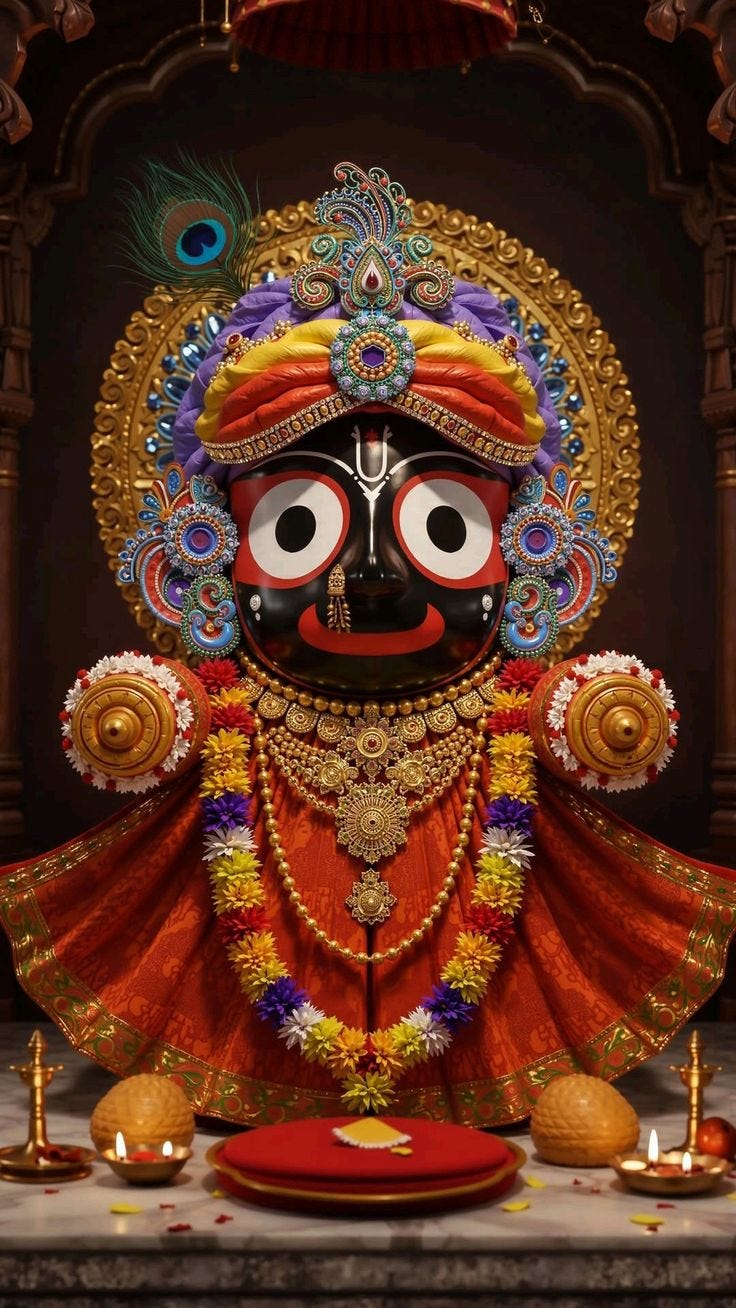
Have you seen the large, unblinking eyes of Lord Jagannatha at Puri? Those are the eyes that constantly watch over the devotees, not in judgement, but in a continuous shower of compassion. It is said that His eyes are so big because He has opened them very wide to find the tiniest bit of good in us, so that He can bless us. His eyes can see all our faults, and yet, so great is His karuna that it blinds Him to our faults!

The Vedas say the Lord has the Sun and the Moon as His eyes. When He glances on us with the cool Moon-eye, we are blessed. But what if His blazing Sun-eye is triggered by our unending paapakarmas? Won’t He then destroy us as He did Shishupala and Ravana?

To ensure this doesn’t happen, He has created His own ploy.

Image

In Tirumala, where He stands patiently receiving the never-ending queue of devotees, His eyes are largely hidden beneath the broad Thirumann adorning His forehead. In yet another of His leelas, He the Omniscient Lord, has ensured that He “cannot” see our sins clearly!

Yet again, we are the beneficiaries of His unparalleled compassion.

And if we are fortunate enough to feel His grace, and turn towards Him with love, that too is His doing!

The Shanti Parva of the Mahabharata reveals this rahasyam.

जायमानं हि पुरुषं यं पश्येन्मधुसूदनः।
सात्त्विकः स तु विज्ञेयः स वै मोक्षार्थचिन्तकः॥

“JayamAnam hi purusham yam pasyet MadhusUdhana:

SAtvika: sa tu vigyEya: sa vai MokshArttha chintaka:”

“One who receives the glance of Lord Madhusudana at the time of birth, is known to be sattvik and becomes a seeker of moksha.”

Anyone who is a sadhaka, a seeker of the Lord, is so because of the causeless mercy, the nirhetuka Krupa, of the Lord, which He rains down through His glorious eyes.

So, the next time you go to the temple, don’t start reciting from your list of what you want from Him.

Don’t rush to complete the darshan.

Just stand quietly, offer thanks to Him, and pray that He should bless you with His Krupa Kataaksham!

Footnote: I was only halfway through this post, when it was time to visit the Ranganathaswamy temple at Rajajinagar, Bengaluru. Standing in front of Him, it felt as if He was smiling bemusedly and asking,

“Do you think you can really convey the full extent of My kataaksham through mere words?”


Well, dear readers, the answer is for you to say.

Sunday, 1 February 2026

Kausalya Supraja Rama

The forest is silent. The eastern sky is tinged with a mild glow as the sun prepares to rise. The rishi sits up and glances at the face of the young prince sleeping near him. He finds himself unable to look away. Moments turn to minutes as he stares, mesmerized, flitting between emotions of love and awe, amazed at his great fortune to behold this beautiful sight.

Perhaps it is the lightening of the skies, or the chirping of the stirring birds, but now, the rishi wakes from his reverie.

Gently, he calls,

“Kausalya supraja Rama, Kausalya supraja Rama….”

And finds himself about to slip into a trance again….

Using the immense power of his tapas, the rishi finally pulls his eyes away and manages to complete what he was trying to say.

“Kausalya supraja Rama poorvaa sandhyaa pravartate,

utthistha narashaardoola, kartavyam daivamaanhikam!”


“O good son of Kausalya, the dawn is approaching in the east. Wake up, O tiger among men, it is time to perform the daily ritual duties!”

This is Brahmarishi Vishwamitra waking up Rama whom he has brought into the forest to protect his yagna.

Vishwamitra marvels at the great fortune of Kausalya who got to bear this divine child. He wonders how much tapas that mother must have done to be able to glance at this radiant face and wake up this dear child every day.

If he recognizes the divine identity of the young prince, why then is the rishi exhorting Him to perform the daily ritualistic duties? What duties does the Supreme Lord have to perform, and why?

The simple answer is – to set an example for us. Humans tend to look up to great people and emulate their actions. Rama is addressed here as “narashaardoola” – tiger among men. That means He is definitely a great man whom the world will hold up as an ideal for centuries to come.

By performing the nitya anushthaana, Rama must set an example for us to follow.

As Krishna aptly explains in the Bhagavad Geeta,

yad yad acarati sresthas, tat tad evetaro janah
sa yat pramanam kurute, lokas tad anuvartate

Whatever action is performed by a great man, common men follow in his footsteps. And whatever standards he sets by exemplary acts, all the world pursues.

- Bhagavad Geeta, 3.21

The acharyas also give another reason for Vishwamitra waking up Rama thus. Perhaps he is saying, “O Rama, You have taken this human form to annihilate the evil asuraas and rakshasaas. Now is the time for You to wake up from Your life as Dasharatha’s son, and begin to take steps to fulfil the promise given to the devaas!”

If we look closely at Vishwamitra’s call, we realize that he’s calling out to Rama alone. Why not Lakshmana? Because he didn’t see Lakshmana at all!

Well, Lakshmana never left Rama’s side, then where was he when Rama was sleeping?

Actually, this is the form that Vishwamitra saw….

Rama sleeping ON Lakshmana ! 

The Lakshmana who was none other than Adishesha!


Look at this beautiful form. Is it any wonder that Vishwamitra was so fascinated?

And once you come out of your reverie of gazing on this divine Lord, perhaps you will want to go back and yourself say those words uttered by Vishwamitra.

“Kausalya supraja Rama poorvaa sandhyaa pravartate,

utthistha narashaardoola, kartavyam daivamaanhikam!”


And just in case you haven’t recognized it yet, and are wondering why this sounds so familiar, it’s probably because you’ve often heard M. S. Subbulakshmi singing it as the first verse of the Venkateshwara Suprabhatam!

Thursday, 15 January 2026

The Best Harvest

As she went about her housework, there was a call from someone outside the door.

“Swamin, we are Srivaishnavas traveling to the next village. Can we get some water to quench our thirst?”

The lady hurried out, welcomed the tired travellers, seated them comfortably and offered them water, noting their fatigue.

“My husband has gone out somewhere, but you are welcome to rest here. Please wait for a while, and partake of some food in our humble abode.”

The weary travellers gladly agreed to the offer.

She rushed inside, got the wood fire going, and pulled out the pots and pans to start cooking. Peering into the grain bin, she was dismayed. The rice in it was too less to suffice for the entire group of people she had promised to feed!

She rushed to the store room. No rice there either!

Panic-stricken, she fell back on her first resort in such situations.

She began praying to her Acharyar and chanting the names of the Lord, as her gaze darted here and there in the store room.

In a few minutes, she walked back into the kitchen, carrying a small bundle in her hand, and began cooking in earnest.

Pic courtesy: https://www.instagram.com/p/C1W151ASJJX/ 

One hour later, the Srivaishnavas had been served, and they left, thanking and blessing the woman for her kind hospitality.

The next morning, the woman’s husband returned home. He had brought along someone to help with the work of sowing their fields. Rummaging amongst the sacks in the store room, he called out to his wife.

“Have you seen the bundle of paddy I had saved up to sow our next crop? I’m sure I had kept it here, but it seems to have disappeared!”

She walked up to him with a tremulous smile.

“The sowing has been completed.”

“What?! How? When? By whom? Don’t tell me the crop is ready to be harvested, too!” the farmer chided.

“Yesterday, I did the sowing. And we will harvest the crop in Srivaikuntham, although I don’t know when exactly that will happen!”


In the Bhagavad Geeta, Sri Krishna says:

अद्वेष्टा सर्वभूतानां मैत्र: करुण एव च | 

निर्ममो निरहङ्कार: समदु:खसुख: क्षमी || 13||

सन्तुष्ट: सततं योगी यतात्मा दृढनिश्चय: | 

मय्यर्पितमनोबुद्धिर्यो मद्भक्त: स मे प्रिय: || 14||

adveṣhṭā sarva-bhūtānāṁ maitraḥ karuṇa eva cha
nirmamo nirahankāraḥ sama-duḥkha-sukhaḥ kṣhamī

santuṣhṭaḥ satataṁ yogī yatātmā dṛiḍha-niśhchayaḥ
mayy arpita-mano-buddhir yo mad-bhaktaḥ sa me priyaḥ


Bhagavad Geeta Chapter 12, verses 13-14

"Those devotees are very dear to Me who are free from malice toward all living beings, who are friendly, and compassionate. They are free from attachment to possessions and egotism, equipoised in happiness and distress, and ever-forgiving. They are ever-content, steadily united with Me in devotion, self-controlled, of firm resolve, and dedicated to Me in mind and intellect."


मत्कर्मकृन्मत्परमो मद्भक्त: सङ्गवर्जित: | 

निर्वैर: सर्वभूतेषु य: स मामेति पाण्डव || 55||

mat-karma-kṛin mat-paramo mad-bhaktaḥ saṅga-varjitaḥ
nirvairaḥ sarva-bhūteṣhu yaḥ sa mām eti pāṇḍava

Bhagavad Geeta Chapter 11, verse 55

Those who perform all their duties for My sake, who depend upon Me and are devoted to Me, who are free from attachment, and are without malice toward all beings, such devotees certainly come to Me.

On today's auspicious occasion of Pongal and Makara Sankranti, let us pray that the Lord guides us to strive for the right harvest!

Tuesday, 30 December 2025

Vaikuntha Ekadashi Experience 2025

Dec 29, 2025

I casually browse through a blog that has details of ancient temples in and around Bengaluru. One temple catches my eye. I read up about it from multiple sources and find the phone number of the archakar serving there. I call him and confirm that indeed, the temple will be open for Vaikuntha Ekadashi from 5.30 am to 7.30 pm.

Hubby is enthusiastic about exploring this new kshetra, and surprisingly, son is also more than willing to come!

Dec 30, 2025


We leave home by 6.45 am and reached the Sugganahalli Sri Lakshmi Narasimha and Garuda temple by 8.10 am.


The temple is more than 1,000 years old, built by the Cholas, and later expanded by the Hoysala and Vijayanagara dynasties. The special feature is that Sri Lakshmi Narasimha in this temple is in a standing posture (unlike most temples where He is seated) and faces west (unlike most temples where He faces east).

This temple is also renowned for the powerful Garuda, vahana of the Lord, who is offered daily worship, and revered by devotees who wish to get rid of sarpa dosha or health ailments.

(To know more about this temple, please check this link…
https://myadhyatm.com/sugganahalli-garuda-temple-ramanagarakarnataka/ )

The temple is in a serene, rural area.


A steady trickle of devotees arrives to take darshan. They say their prayers, then pass through the Vaikuntha Dwara, accept prasadam, sit for a few minutes, and take leave of the Lord. None of the crowd and clamour that is so common in the well-known, bigger temples of our city.


We take our time, too. We stand in front of the Lord’s Sannidhi, reciting stotras and shlokas, our hungry eyes drinking in His glorious form. We walk slowly through the Vaikuntha dwara, praying for an equally easy journey to Srivaikuntha when our time comes. We offer our contribution, and receive teertha and prasadam. We offer unhurried prayers at all the other smaller sannidhis in the temple complex. 

We climb to the terrace and get to see the vigrahas that form part of the gopurams. We soak in the silence, get a beautiful view of the temple surroundings and finally, take a few photographs to capture memories of this divine visit.


As we are about to leave, I notice one lady devotee who seems to be in some kind of pain. She begs Garuda, loudly saying, “Make my hand recover, Garuda, and I’ll arrange an utsava for you!”

One little boy walks in, stands with eyes closed, hands folded in namaskar mudra, and chants a few shlokas. I compliment him on his recitation, and ask who taught him the chants, and shyly, he says “My father, and my Sir.”

Next, we travel about 1.5 kms away to the Kambada Narasimha temple, which houses the udbhava murthy of Lord Narasimha emanating from the pillar. The main door is locked, but we get darshan through a window thoughtfully left open. One or two local devotees come there, light karpoora, offer their prayers and leave.


What happens after this is one of those peculiar events that one cannot explain with worldly logic.

While coming to Sugganahalli, we have seen a temple a little far from the highway, which seems to beckon us to come there. Google Maps says it is the Madgondanahalli Ranganatha Swamy temple, and we decide to visit it on our way back home.

We put in that temple as our destination, and Google Maps takes us to a temple. But not the one that we saw and wanted to visit. Later, my son discovers that there are about 3 to 4 Ranganatha Swamy temples in the area.


We walk in to offer prayers at the temple to which we have been brought. There is a goushala there, and we offer respects to goumata, too. The priest is away, but his mother opens the door and allows us to have darshan. There are only two pillars in the sanctum, and the lady says one of them is Ranganatha, and the other is Narasimha. We hand over the coconut, flowers, and dakshina we have brought along.

As we walk out from this temple, wondering over how we landed up here without ever planning to, hubby remarks, “Probably, we have some past janma account that had to be settled with this place, and so, the Lord Himself brought us here for that!”

That sets me thinking.

When we try to make it a habit to surrender to the Lord’s will, His grace flows abundantly and effortlessly in our life. He takes care of everything for us. Embarking on this journey then leads us to the most amazing destinations.

On this auspicious day of Vaikuntha Ekadashi, I feel humbled by immense gratitude for the grace of Srimannarayana that weaves through our life, creating a beautiful tapestry of moving and meaningful experiences that draw us closer to His lotus feet!


Tuesday, 16 September 2025

The Lucky Pot

 The little boy ran for His life, afraid of the wrath of His mother Yashoda.

There was no place to hide from her.

Suddenly, He noticed the milkman Dadhipandyan resting under a tree after having completed his day’s sales.

He rushed to him and begged,

“Please save me from my mother. Can I hide inside your pot?”

Dadhipandyan agreed and the little boy climbed into the pot and crouched inside. The milkman covered the pot with the cloth of his turban, and rested his head on it.

Yashoda reached there a few moments later, questioned Dadhipandyan, and went away wondering where her kid had disappeared in just a few seconds.

The danger had passed.


Baby Krishna knocked on the pot from inside, and shouted,

“Let me out, Dadhipandya.”

The man refused to do so.

The Master of the Universe pleaded with the lowly milkman.

“I’ll give you whatever you ask for, please let me out!”

“Ok, I’ll let you go, but in return, grant me moksha!”

Krishna was shocked. Never in history had anyone ever made such a ludicrous demand!

But the man wouldn’t relent.

Desperate for a release from the smelly pot, Krishna agreed.

Still, Dadhipandyan made no move to release Him.

“What more do you want?”

“You are the friend, protector and refuge for the entire world and all things in it. Once I’m gone, what will my poor pot do alone? You must grant moksha to my pot, also!”

This was more ridiculous than the previous demand! When did any non-sentient object ever get liberated?

But then, wasn’t He known as Achyuta? The One who is infallible, and who will never desert His bhaktas? How then could He not agree to Dadhipandyan’s demand?

And so it was that not just the illiterate milkseller devotee, but his inanimate pot also got liberated from this world!

Many aeons later, He got reminded of this incident in the most unlikely of situations. 


Lord Ranganathar of Srirangam lay serenely on His serpent bed. One of His devotees sat in front of Him, making flower garlands as he did every day. Suddenly, the bhakta felt overwhelmed with the thought of how nice it would be to be with the Lord in Srivaikuntham, with no interruption in his seva.

Moved by this feeling, he said to the Lord,

“I’ve had enough of this samsara! I need moksha right now! When are you going to grant me the fortune of doing eternal kainkaryam to You?”

The sleeping Lord sat up in surprise.

“Pillai Perumal Iyengar, do you think it is so easy to get moksha? There are so many great rishis and yogis and saints who dedicate many births, undertake penance of the highest order, attain knowledge, and still struggle for moksha. How can an ordinary human like you assume you will get what those great souls cannot?

What penance have you done?

Have you performed yagnas?

Have you perfected the study of the Vedas?

Have you fasted in My name?

Have you cried out with deep longing for Me, and Me alone?”

Unfazed by the Lord’s tirade, His bhakta gazed calmly at Ranganathar, choosing his words carefully.

“Do you really consider all these things before granting moksha? I don’t think so!”

The Lord thundered,

“How dare you doubt My words?”

Pat came the reply.

“If you really considered these qualifications, then how is it that when you came as Krishna, You liberated the pot of Dadhipandyan?”

“What dhyana yoga or jnana yoga or bhakti yoga did that pot do?

What penance or yagnas did it perform?

What Vedas did the pot study?

What upavasa did it perform?

Did that black and dirty pot pray to You with longing for You and You alone?

Am I less qualified than that pot?”

Stumped for an answer, all that Lord Ranganatha could do, was to fall back on His serpent bed, marvelling at the irrefutable logic of His bhakta!

On today’s auspicious occasion of Krishna Jayanti, let us pray for His grace to uplift us just as it did Dadhipandyan and his pot. 

May Achyuta bless us with eternal devotion towards His lotus feet, which are the both the means and the end!


Sunday, 24 August 2025

Why the Lord Wears Urdhva Pundram on His Forehead?

Baby Krishna lay asleep on the floor where Yashoda had left Him, as she went to attend to her household duties.

Nanda had to go outside for some work, but he was wary of leaving the baby alone. Some gopa kids were running around the place, but they could not be relied upon to protect his precious baby.

So, he followed what was a common gopa custom – he placed the wheel of an old cart near the baby, to ward off any danger from evil sources. He left home, reassured that no harm would come to little Krishna.

Source: https://godivinity.org/wp-content/uploads/2019/06/IMG-20190613-WA0020-231x300.jpg

Unknown to him, the demon Shakataasura sent by Kamsa, had entered that very same wheel. The plan was to fall on the baby and crush him, making the entire event appear like an accident.

Rakshasa proposes, God disposes!

Baby Krishna woke up, and like children all over the world do, He began to wail for His mother, flailing his tiny arms and legs about.

The next instant, one baby leg extended, and kicked the wheel with the hidden demon!

There was a loud crashing sound, and hearing that, Yashoda raced to her little one, scared for His safety.

As she clutched Him to her, and smothered Him with kisses while simultaneously examining Him for injuries, one of the gopa boys who had been playing nearby came to her.

Wide-eyed with wonder, he said to Yashoda, “Baby Krishna kicked the cart wheel and it shattered into pieces!”

Yashoda refused to believe him. “What nonsense! See my baby’s feet – so tiny and delicate! Do you think they can do what you say?”

Baby Krishna’s face split into a huge grin and the gopa boy could swear the baby actually winked at him!

All Srivaishnavas wear the Urdhva Pundra on their forehead (and the men, on 11 other spots on their body). This is called as the Tirumann Kaapu – literally translating into “The Sacred Clay that Protects.” The two vertical white lines of the Urdhva Pundra denote the Lord’s lotus feet, and the central red / yellow line denotes Mahalakshmi Devi.
Example for Tirumann😊
When devotees apply the Tirumann Kaapu on their forehead, they signal their eternal servitude (daasatva) to the Divya Dampati, and show that they only depend on Srimannarayana for their protection. (The word “Kaapu” means “protection”)

You must have seen pictures of Lord Venkateshwara of Tirumala. What do you first notice about His face? Of course, the same Tirumann Kaapu!

Source: https://indianfolkart.org/wp-content/uploads/2020/11/TNJ-PAINT-7-1.jpeg.webp

We wear that mark so that we get His protection. But then, why does He wear that mark on His own forehead?

Azhwar beautifully explains the reason using the Shakataasura episode we described before. He says, “I always knew that Your holy feet protect me. But now I realized that Your holy feet protect You also! With those tiny Feet only You protected Yourself from the evil asura!”

When Putana’s life had been sucked out by baby Krishna, she had reverted to her hideous rakshasa form.

But in case of Shakatasura, there is no mention of his form even being discovered. Why was that so?

The Acharyas explain that the divine feet of the Lord only purify and grant liberation; They never destroy. When He kicked Shakataasura with His foot, the demon’s body disintegrated, and he got moksha instantly, and therefore, there was no trace of his body.

Another explanation for why the Lord sports the Urdhva Pundra comes from the incident when the Lord once got Swami Ramanujacharya to apply the Tirumann on His forehead, and became his disciple! (Read this old post if you haven’t already)

But perhaps, can it be possible that just as the devotees declares his servitude to the Lord by wearing the Tirumann Kaapu, the Lord is proclaiming His servitude to His devotees by wearing the same Tirumann on His forehead ?

For, it was this very Lord Srimannarayana, who told Rishi Durvasa during the Ambarisha episode, 


Source: https://vedabase.io/en/library/sb/9/4/63/ 

“I am completely under the control of My devotees. Indeed, I am not at all independent. Because My devotees are completely devoid of material desires, I sit only within the cores of their hearts. What to speak of My devotee, even those who are devotees of My devotee are very dear to Me.”


Tuesday, 5 August 2025

The Eternal Friend

Mount Govardhan had been worshipped.

He had accepted all the prasad.

Indra had flown into a rage.

Torrential rain had flooded Vrindavan.

Instinctively, all had turned to Him for solace.

And that delicate son of Nanda had done the unimaginable.

He had lifted up Govardhan on the tip of His little finger.

Effortlessly.

And held it like that for 7 days and nights.


Sheltered from the storm, the brajavasis had been in ecstasy.

For they had been able to gaze, uninterrupted by mundane activities, on that radiant, smiling face.

No one had felt hungry or thirsty or tired or worried.

After 7 days, the clouds had been exhausted.

The sun had come out shining bright.

He had forced everyone to return home, and gently set down Govardhan.

As they turned to leave, one of the gopa boys had a sudden moment of realization.

He asked in wonder:

“How did You have the strength to hold up this great mountain for all this time? 

Who are You? Are You a God, or a Gandharva, or a Yaksha or a Danava?”

The smile vanished from Krishna’s face.

yadi vo’sti mayi prItih SlAghyo’ham bhavatAm yadi    |

            tad-Atam-buddhi sadRSI buddhir-vah kriyatAma mayi    || 

nAham devo na gandharvo na yaksho na ca dAnavah    |

            aham vo bAndhavo jAtah na vaS-cintyam ato’nyatA   ||   

-- (VishNu purANam 5.13.11 & 12)

“If you have real love for me and think that I am worthy of praise from you, then you must think of me as you think of yourselves (i.e., you must think of me as a gopa, as you all are).  I am neither a god, nor a gandharva, neither a yaksha (a demi-god), nor a dAnava (demon).  I am a born relative to you all.  You must not think of me any other way”!

He flashed that beautiful smile at the gopa boy.

And the veil fell firmly back in place.

The gopa boys ran home, and laughing aloud, He rushed along with them.

Those innocent boys that day composed a song that is still sung in Brajabhumi.

कछु माखन के बल बढ्यौ - ब्रज के दोहे

He wants us to think of Him as one amongst us.

He’s seated within, waiting silently, through all the births we have taken.

All we need to do is turn to Him, and He will lift the mountain of this samsara, sheltering us from all storms, and drown us in the ecstasy of His charming smile!