He spoke, determined to find out all about them without revealing anything about himself.
Yet, the very next moment, the truth slipped out.

“I am Hanuman, minister of the great King Sugriva, and he has sent me to say he wants to have friendship with you.”
Before Rama had even spoken a word, His mere look made Hanuman give up the subterfuge.
This shows us the power of Bhagavat Kataaksham – the gaze of the Lord.
But how does this happen?
The Mundaka Upanishad explains:
भिद्यते हृदयग्रन्थिश्छिद्यन्ते सर्वसंशयाः ।
क्षीयन्ते चास्य कर्माणि तस्मिन्दृष्टे परावरे ॥ ८ ॥
bhidyate hṛdaya-granthiś chidyante sarva-saṁśayāḥ |
kṣīyante cāsya karmāṇi tasmin dṛṣṭe parāvare ||
“When the Supreme Lord is seen, the knot of the heart is untied, all doubts are cut asunder, and the chain of karma is destroyed.”
In front of those Divine Eyes, what chance did Hanuman stand?
Before Rama had even spoken a word, His mere look made Hanuman give up the subterfuge.
This shows us the power of Bhagavat Kataaksham – the gaze of the Lord.
But how does this happen?
The Mundaka Upanishad explains:
भिद्यते हृदयग्रन्थिश्छिद्यन्ते सर्वसंशयाः ।
क्षीयन्ते चास्य कर्माणि तस्मिन्दृष्टे परावरे ॥ ८ ॥
bhidyate hṛdaya-granthiś chidyante sarva-saṁśayāḥ |
kṣīyante cāsya karmāṇi tasmin dṛṣṭe parāvare ||
“When the Supreme Lord is seen, the knot of the heart is untied, all doubts are cut asunder, and the chain of karma is destroyed.”
In front of those Divine Eyes, what chance did Hanuman stand?

Nammazhwar knew this secret power of the Lord’s gaze. He begged the Lord repeatedly to bless Him with His darshanam.
Playfully, the Lord chided him, saying “You have so many paapas, how can I bless you?”
Desperate Nammazhwar pleaded, “You don’t have to bless me, at least just come and stand in front of me!”
Not realizing the ploy, the Lord acquiesced and appeared in front of Nammazhwar.
The very next moment, He found Himself pronouncing blessings!
The devotee had tricked the Lord. The obstacles posed by his sins were razed by the Lord’s own gaze! Now that the devotee was purified, the Lord’s blessings flowed spontaneously!
Playfully, the Lord chided him, saying “You have so many paapas, how can I bless you?”
Desperate Nammazhwar pleaded, “You don’t have to bless me, at least just come and stand in front of me!”
Not realizing the ploy, the Lord acquiesced and appeared in front of Nammazhwar.
The very next moment, He found Himself pronouncing blessings!
The devotee had tricked the Lord. The obstacles posed by his sins were razed by the Lord’s own gaze! Now that the devotee was purified, the Lord’s blessings flowed spontaneously!
 |
| Image |
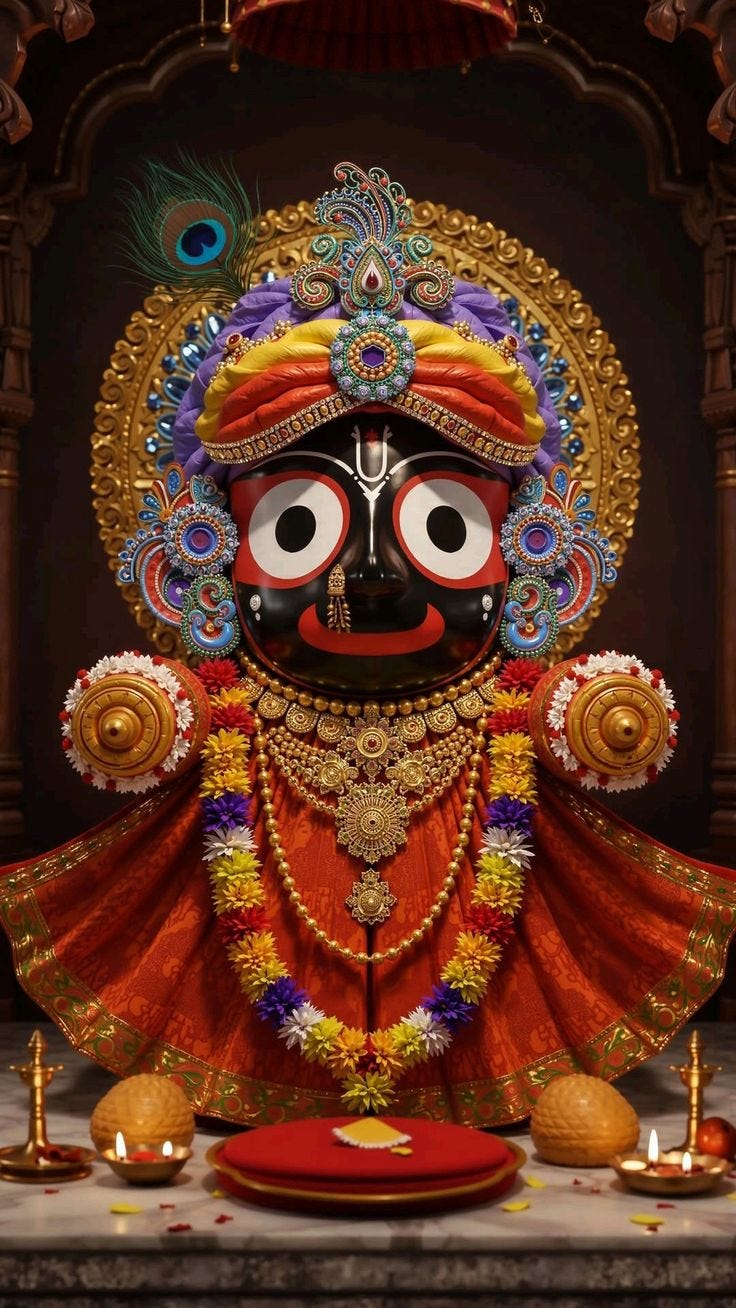
Have you seen the large, unblinking eyes of Lord Jagannatha at Puri? Those are the eyes that constantly watch over the devotees, not in judgement, but in a continuous shower of compassion. It is said that His eyes are so big because He has opened them very wide to find the tiniest bit of good in us, so that He can bless us. His eyes can see all our faults, and yet, so great is His karuna that it blinds Him to our faults!
The Vedas say the Lord has the Sun and the Moon as His eyes. When He glances on us with the cool Moon-eye, we are blessed. But what if His blazing Sun-eye is triggered by our unending paapakarmas? Won’t He then destroy us as He did Shishupala and Ravana?
To ensure this doesn’t happen, He has created His own ploy.
 |
| Image |
In Tirumala, where He stands patiently receiving the never-ending queue of devotees, His eyes are largely hidden beneath the broad Thirumann adorning His forehead. In yet another of His leelas, He the Omniscient Lord, has ensured that He “cannot” see our sins clearly!
Yet again, we are the beneficiaries of His unparalleled compassion.
And if we are fortunate enough to feel His grace, and turn towards Him with love, that too is His doing!
The Shanti Parva of the Mahabharata reveals this rahasyam.
जायमानं हि पुरुषं यं पश्येन्मधुसूदनः।
सात्त्विकः स तु विज्ञेयः स वै मोक्षार्थचिन्तकः॥
“JayamAnam hi purusham yam pasyet MadhusUdhana:
SAtvika: sa tu vigyEya: sa vai MokshArttha chintaka:”
“One who receives the glance of Lord Madhusudana at the time of birth, is known to be sattvik and becomes a seeker of moksha.”
Anyone who is a sadhaka, a seeker of the Lord, is so because of the causeless mercy, the nirhetuka Krupa, of the Lord, which He rains down through His glorious eyes.
So, the next time you go to the temple, don’t start reciting from your list of what you want from Him.
Don’t rush to complete the darshan.
Just stand quietly, offer thanks to Him, and pray that He should bless you with His Krupa Kataaksham!
Footnote: I was only halfway through this post, when it was time to visit the Ranganathaswamy temple at Rajajinagar, Bengaluru. Standing in front of Him, it felt as if He was smiling bemusedly and asking,
“Do you think you can really convey the full extent of My kataaksham through mere words?”
Well, dear readers, the answer is for you to say.